

- Karen Kassanoff
HOW TO BUY SCHOOL FURNITURE: BIDS, CONTRACTS & PURCHASING CO-OPS
Understanding how to buy school furniture starts with knowing your purchasing options. Most schools and districts purchase furniture in one of four ways: a direct quote, a formal bid, a purchasing cooperative, or a state contract. The right approach depends on the size of the purchase, your district’s purchasing requirements, and how quickly you need the furniture.
Smaller purchases often go by direct quote. Larger ones usually need a competitive bid or a pre-approved contract, which can save weeks of paperwork. This guide explains each path, what to have ready before you ask for pricing, how long each step takes, and which questions to ask before you place an order.
This guide is for school administrators, district purchasing staff, architects, designers and dealers planning school furniture purchases.
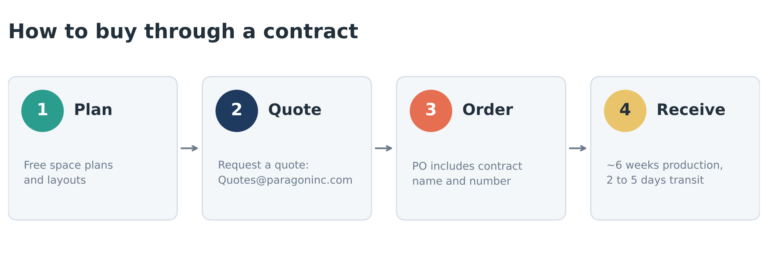
The purchasing process generally follows four steps: plan, request a quote, place an order, and receive the furniture The four paths differ mainly in how much competition and paperwork the district has to document. Your district’s purchasing office can tell you which one applies, because dollar thresholds vary by state and by district.
four ways schools purchase furniture
Most schools and districts buy furniture through a direct quote, a formal bid, a purchasing cooperative or a state contract. Which one applies depends on the size of the purchase and your district's purchasing rules.
| Purchasing path | How it works | Best when |
|---|---|---|
| Direct quote | You send a room list to a dealer and receive an itemized quote, then follow your district's approval process. | The purchase is small enough that your district doesn't require a formal bid. |
| Formal bid | The district publishes a specification (an RFQ or RFP) and vendors submit competing offers. | The purchase is large, or district rules require competition and no eligible contract covers the products. |
| Purchasing cooperative | A co-op has already competitively awarded the contract. Member schools order from the awarded vendor at pre-negotiated pricing. | Your district is a co-op member and the product line is covered by an active contract. |
| State contract | The state has already awarded a contract that schools and public agencies can buy from without running their own bid. | Your district is eligible to use the state contract and it covers the products you need. |
Buying for a Classroom Refresh or New Campus?
Classroom refresh. A classroom refresh might include 24 A&D® Koi student desks, 24 READY™ chairs, two storage units and teacher furniture. The school can send a room list to its dealer for an itemized quote, then follow the district’s approval process.
New campus. For a new campus, a district might start with a standard layout for 10 classrooms serving 30 students each. The district and its dealer can use that layout to build a furniture list by room, confirm quantities and delivery phases, and determine whether a formal bid or an eligible purchasing contract fits the district’s requirements. Knowing how to buy school furniture for projects of different sizes helps districts select the right purchasing process before requesting quotes.
Buying School Furniture Through Purchasing Co-ops and State Contracts
A purchasing cooperative lets a school buy at pre-negotiated pricing without running its own bid. The co-op has already competitively solicited and awarded the contract, so members can order directly from the awarded vendor. Many states, including Texas, also keep their own contracts for schools and public agencies.
The rules differ by state, and some districts have their own requirements on top. Before ordering through any contract, confirm three things with your purchasing office:
- Your district is a member of the co-op, or is eligible to use the state contract.
- The product line you want is covered by the awarded contract.
- The contract is active and has not expired.
For districts exploring how to buy school furniture through cooperative purchasing, confirming contract eligibility is an important first step.
Contracts Paragon is available through
Paragon’s contract options include:
- Purchasing cooperatives: Equalis (including Nexus dealers), ESCNJ, KCDA, MAPT Frederick, MHEC, PEPPM and TIPS
- State contracts: Alabama, Mississippi, New York (PC70256), North Carolina, Pennsylvania and South Carolina to name a few.
Each contract has a summary showing its contract number, covered products, any exclusions, and start and end dates. Ask your dealer or Paragon to confirm which contract is active, whether your district is eligible and whether it covers the products and services you need.
What to include on your purchase order
Schools typically order through a dealer. Paragon can connect you with a dealer if you don’t have one you are currently working with. Before issuing a purchase order, ask your dealer or Paragon to confirm the contract name and number, any required references and documentation, and instructions for submitting the order. When ordering Quick Ship items, include “Quick Ship” on the purchase order.
What goes into a furniture spec or bid
A clear specification gets you comparable bids and avoids surprises at delivery. Whether you write the spec yourself or an architect or designer does, these are the items to settle first.
- Quantities and room types. Count desks, chairs, tables, storage and soft seating by room. The classroom space planning guide helps you estimate how many pieces fit.
- Sizes by grade level. Match seat and desk heights to the students using them. Use the Paragon sizing guide.
- Materials and tops. Choose top and edge options for durability and cleaning. See the table top options.
- Colors, finishes and fabrics. Request color samples before you finalize, since screens misrepresent color.
- Safety and performance requirements. Specify the ANSI/BIFMA standards that apply to the products you are ordering. Review Paragon’s school furniture safety standards guide.
- Warranty terms. Compare coverage length and what it excludes. Paragon’s warranty terms are posted online.
- Drawings and files. Architects and dealers can use Paragon’s CAD, Revit and CET symbols, cut sheets and design typicals. They are on the K-12 furniture design resources
Best value, not only lowest price
A bid that compares only unit price can hide differences in durability, warranty and replacement cost. Consider asking for pricing alongside lifetime performance. The article on total cost of ownership explains how to compare options this way.
Paragon can help with sample specification language, product recommendations, compliance documents and bid submissions. Contact quotes@paragoninc.com.
Where the money comes from
Start with your district’s purchasing and grants offices to identify funding and confirm which purchases qualify. Ask about deadlines and required documentation before committing to a purchase.
Common sources today include:
- Operating and capital budgets. Routine replacements and classroom refreshes often come from the district’s regular budget.
- Bond programs. Voter-approved bonds typically fund new buildings, additions and major renovations, including the furniture that goes in them.
- Federal program funds. If you plan to use a federal award, ask your grants office to confirm that the proposed furniture purchase is an allowable expense under that award.
- State programs and grants. Many states offer facility, technology or career-education funding. Look at your state education agency’s website.
- Foundations, PTA groups and community donations. These work well for makerspaces, libraries and reading nooks, where a specific project can be pitched.
For a longer list of ideas, see Paragon’s article Ten Strategies to Boost Your Education Funding.
For grant applications, Paragon can provide quotes, product descriptions and letters of authorization. Contact quotes@paragoninc.com.
School Furniture Purchasing Timeline: From Quote to Installation
Start with the date you need the furniture ready for students. For a standard order, allow about six weeks for production after order acknowledgment, plus typically 2 to 5 days in transit. Schedule receiving, assembly and installation separately. Installation time varies with the size of the project.
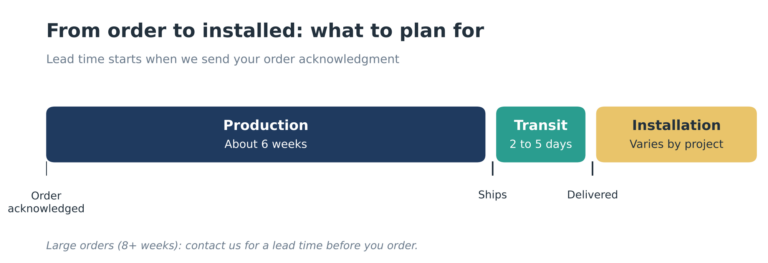
From order to installed: production, transit and installation
Most projects follow the same steps:
- Plan the space and count the furniture needed by room.
- Request a quote or price list, and request samples if needed.
- Complete the district’s bid, contract or approval process.
- Issue the purchase order.
- Furniture is prepared and scheduled for shipment.
- Delivery, inspection and documenting any damage. Paragon’s shipping and delivery guide covers what to check.
- Assembly and installation, if included.
Typical lead times
Lead times begin when Paragon has fully processed the order and sent the acknowledgment. The timeframes above cover the period before shipment. Allow separate time for transit and installation. Browse the Quick Ship product list for eligible items and program terms.
Standard production lead times generally stay consistent through the summer. Confirm timing early for large orders or projects with a firm school opening date, and allow time to receive and set up the furniture.

How Paragon Helps Schools Plan and Purchase Furniture
Paragon works closely with authorized dealers throughout the country to help schools plan and purchase furniture for classrooms, libraries, makerspaces and other learning environments.
Space Planning and Product Selection
Paragon provides complimentary space plans and layout drawings to help schools determine the right furniture, quantities and configurations for their learning environments.
Quotes and Purchasing Support
Paragon and its dealer partners help schools with product selection, pricing and purchasing information. Freight quotes are available at the time of the initial quote request or before submitting a purchase order.
Delivery and Installation
Dealers can coordinate delivery and installation based on project needs. Paragon provides product installation instructions and customer service support to assist with questions or issues during installation.
Questions worth asking any dealer or rep:
- Can you order through our co-op or state contract, and what is the contract number?
- Can you provide a space plan or layout drawing for this project?
- What is the lead time for these exact items and quantities?
- Who handles delivery, inspection and installation?
- How are damaged or missing items resolved, and how fast?
- What does the warranty cover, and who do we call for a claim?
If you are a dealer working on a school project, Paragon also has project registration and a sales reference guide.
Check these items before you issue a purchase order, since mistakes found after delivery cost the most to fix.

FREQUENTLY ASKED QUESTIONS:
Do schools have to bid out furniture purchases?
Often yes, but it depends on the dollar amount and your state and district rules. Purchases above a set threshold usually require a competitive bid, unless you buy through a co-op or state contract that was already competitively awarded. Ask your purchasing office for the current threshold.
What is a purchasing cooperative?
A purchasing cooperative is a group of public agencies that pools buying power and awards contracts to vendors through a competitive process. Member schools can then buy from those vendors without running their own bid. Your district must be a member or eligible to use the contract.
How long does school furniture take to arrive?
Standard orders typically take six weeks in production. Eligible Quick Ship orders typically ship in 5 to 15 business days, subject to availability. Add transit and installation time, and request a schedule for large orders.
What should I include in a furniture bid specification?
Include quantities by room, sizes by grade level, top and edge materials, colors and finishes, safety standards such as ANSI/BIFMA, warranty requirements and delivery terms. CAD and Revit symbols, cut sheets and design typicals help vendors price accurately.
How do I choose between the lowest price and the best value?
Compare more than the unit price. Durability, warranty length, repair and replacement costs, and how long the furniture stays useful all affect what a school actually spends over time. A longer-lasting product at a higher price can cost less over its life.
Who inspects the delivery, and what if something is damaged?
Assign someone to inspect the shipment, note visible damage or shortages on the delivery paperwork before signing and take photos. Contact your dealer or email servicerequest@paragoninc.com with the order details. Paragon reviews the claim to determine whether it is covered and can provide a replacement quote when applicable.
Can I get help with a space plan before I buy?
Yes. Paragon provides complimentary space plans and layout drawings. Share your room dimensions, grade levels, student counts and project goals with your dealer or Paragon representative.
Ready to Start Your School Furniture Project?
Ready to take the next step? If you still have questions about how to buy school furniture, start by sharing how many rooms you’re furnishing, the grade levels, and your desired delivery date. Paragon can help you identify the right purchasing path.
Questions? Call (800) 451-8546 or email quotes@paragoninc.com.
Related reading: The true cost of school furniture, Classroom space planning 101, School furniture shipping and delivery.