Designing with nature: How Balance, Momentum, Growth, and Efficiency Shape the Future of Learning Environments
We’re honored to be published in the 2026 Winter issue of Essentials from EDmarket. The featured article, Designing with Nature, explores how principles found in nature can guide thoughtful, student-centered learning environment design..
Our article, Designing with Nature: How Balance, Momentum, Growth, and Efficiency Shape the Future of Learning Environments, explores how these core principles guide thoughtful, student-centered learning space design.
You can begin reading Paragon’s featured article here:
https://essentials.edmarket.org/2026/01/designing-with-nature-how-balance-momentum-growth-and-efficiency-shape-the-future-of-learning-environments/
To view the full Essentials Winter 2026 publication, visit:
https://essentials.edmarket.org/
Keep scrolling to read the full article below.
The spaces where students learn are far more than a backdrop for education — they actively influence how students feel, behave, and engage. The built environment shapes emotional regulation, focus, collaboration, and a sense of belonging. Much of that influence is defined by the furniture that shapes how students sit, move, gather, and engage throughout the learning day.
As schools continue to rethink what future-ready environments should look like, one truth has become increasingly clear: the most effective learning spaces are not static. They are responsive, intuitive, and human-centered. They move with learners rather than confine them.
Today’s students navigate increasing academic expectations, social pressures, and emotional complexity. Learning environments must rise to meet those demands — not by adding more, but by designing better. Thoughtfully planned spaces reduce stress, support regulation, and foster connection, allowing students to show up more fully for learning.
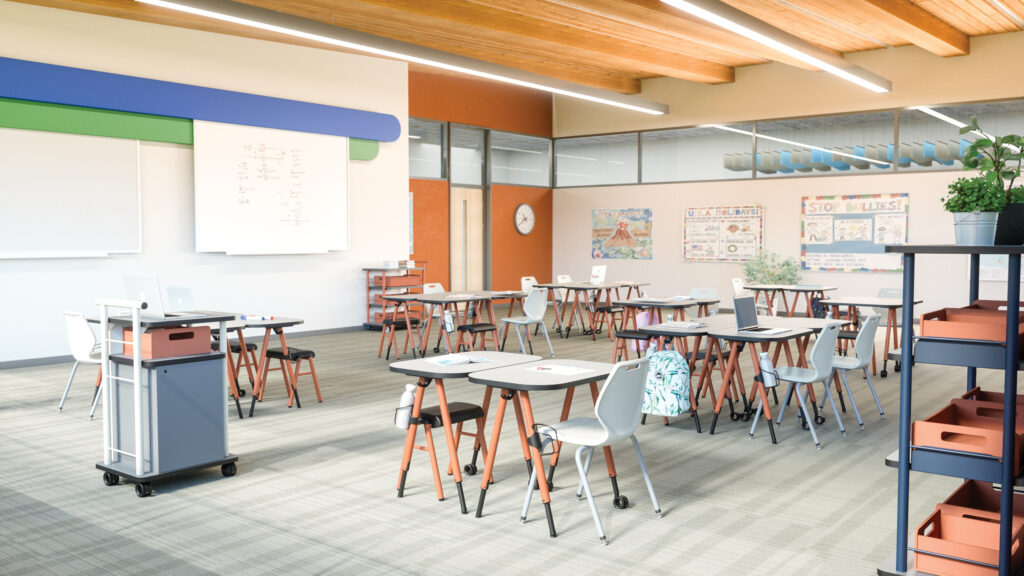
To better understand how environments can support students holistically, designers and educators are increasingly turning to the greatest teacher of all, nature. Natural systems demonstrate how balance is maintained, how energy flows, how growth unfolds over time, and how efficiency sustains long-term success. Nature does not rush, yet it never stands still. It adapts, responds, and evolves — qualities that closely mirror how meaningfull learning actually occurs.
From these observations emerge four foundational design principles that help guide effective learning environments: Balance, Momentum, Growth, and Efficiency. Together, these principles form a framework for designing spaces, and the furniture within them, that support emotional well-being, cognitive engagement, and social connection.
At the heart of this philosophy lies a simple truth: Engagement exists at the intersection of belonging, emotion, and the built environment.
When those forces align, students feel connected, confident, and ready to learn.

BALANCE: Stability Meets Simplicity
Nature is defined by movement. Water flows, wind shifts, and living systems adapt continuously. Learning follows the same rhythm, it is active, dynamic, and rarely linear. Environments that support momentum allow for movement without disruption. When students can shift posture, reorient themselves, or move between learning modes with ease, both the body and mind stay engaged. These physical adjustments help sustain focus and emotional regulation throughout the day.

From a social-emotional learning perspective, this simplicity matters. When an environment feels calm and predictable, students are more likely to feel calm themselves. Balanced environments support clear expectations, emotional regulation, focused attention, and a sense of safety and belonging.
Balance also supports smooth transitions. Natural ecosystems are constantly shifting, yet remain rhythmic and grounded. Learning environments that mirror this fluidity allow students to move seamlessly between independent work, small-group collaboration, and whole-class instruction. When transitions are intuitive, anxiety decreases and students remain socially connected throughout the day.

MOMENTUM: Energy in Motion
In nature, balance allows systems to thrive. Trees root deeply while reaching upward. Ecosystems maintain order without rigidity. Nothing is excessive, yet nothing is lacking. Learning environments benefit from this same sense of harmony.
Spaces designed with simplicity in mind reduce distraction and bring clarity. Clean lines, intuitive layouts, and visual order help students understand how a space functions without explanation. Just as natural environments calm the nervous system, organized classrooms reduce cognitive overload and support emotional regulation.
Momentum is closely tied to autonomy. When the environment responds to learners rather than restricting them, students feel a greater sense of control and confidence. This responsiveness supports reduced frustration, increased self-efficacy, and deeper engagement. Flexibility also builds resilience. Nature survives through adaptation, and classrooms that encourage flexibility teach students to approach change with curiosity rather than resistance. Moving from focused work to collaboration becomes a natural progression rather than a disruption.

GROWTH: Learning That Lasts
Growth in nature is steady and continuous. It is not rushed, yet it is always moving forward. Learning environments should reflect that same long-term perspective. Consistency across learning spaces plays a critical role in student development. When students encounter familiar design language as they move through grade levels, they experience continuity and belonging. This familiarity reduces anxiety, supports smoother transitions, and builds emotional security.
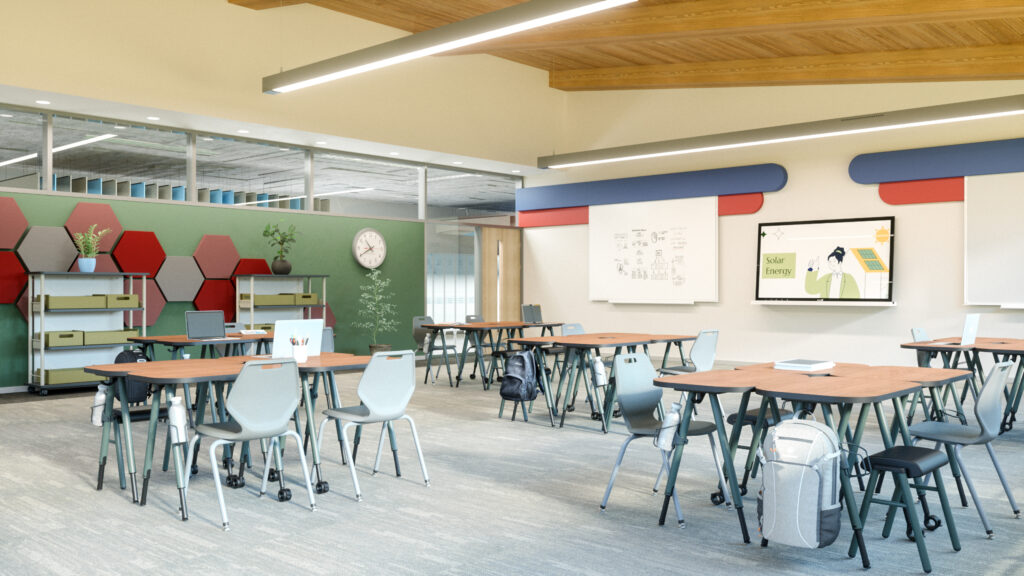
At the same time, environments must be capable of evolving. Teaching methods, technologies, and student needs change over time. Spaces that adapt allow educators and designers to respond without rethinking the environment from the ground up. From a social-emotional learning perspective, adaptability reinforces persistence and resilience. Students learn that change is not disruptive, it is part of growth. When environments evolve alongside learners, students develop confidence in navigating new challenges and optimism about what lies ahead.
EFFICIENCY: More Time for Learning and Connection
Nature is efficient by design. Every structure serves a purpose, and every system conserves energy. There is no excess, only intention.In learning environments, efficiency reduces friction. When spaces are intuitive to set up, easy to reconfigure, and simple to maintain, educators can focus less on logistics and more on students. This efficiency supports calmer starts to the day, smoother transitions, and fewer disruptions.
Clear functionality also supports learning flow. When materials are accessible and movement is unobstructed, classrooms experience less frustration and more uninterrupted time for learning. From a social-emotional standpoint, efficiency creates stability. Predictable environments help students feel secure and confident, freeing cognitive and emotional bandwidth for collaboration, creativity, and relationship-building. When the environment works smoothly in the background, human connection can move to the foreground.

Designing With Nature for the Full Human Experience
Nature teaches us that effective environments are balanced rather than chaotic, fluid rather than static, adaptable rather than fixed, and purposeful rather than wasteful. When these principles guide learning space design, classrooms become ecosystems that support both the emotional and intellectual dimensions of education. Students feel safe,seen, supported, challenged, and connected, not because the space demands it, but because it enables it.
By translating the natural principles of Balance, Momentum, Growth, and Efficiency into furniture solutions, Paragon Furniture helps learning environments better reflect how students learn, grow, and thrive. Designing with nature allows schools to create environments that support the full human experience. The future of educational design is not defined by how classrooms look, but by how they feel, and by the environments and furniture that help bring those experiences to life.