

School Furniture Shipping and Delivery:
How to Prepare, Receive and Inspect Your Order
A practical guide for schools, dealers, facilities teams and installers
Ordering new school furniture is an exciting step in creating better learning environments, but successful delivery requires planning. From confirming access for the freight carrier to inspecting every pallet before signing the delivery receipt, a few important steps can help schools avoid delays, damage disputes and unexpected costs.
Whether you are furnishing one classroom or an entire campus, understanding the school furniture shipping and delivery process will help ensure your order arrives safely and is ready for installation.
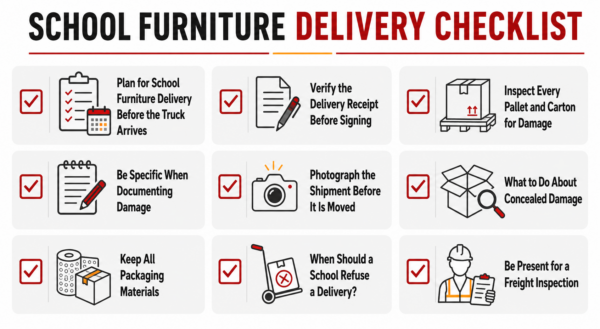
Plan for School Furniture Delivery Before the Truck Arrives
Large school furniture orders are typically delivered by freight carrier rather than a standard parcel service. Before the delivery date, confirm that the school or installation site can accommodate the shipment.
- Is there a loading dock available?
- Will a liftgate be required?
- Can a full-size freight truck access the delivery area?
- Is there adequate space for pallets, cartons and crates?
- Are doorways, elevators and hallways large enough for the furniture?
- Will trained staff or an installation crew be available to unload and move the products?
- Is there a secure, dry area where the furniture can be stored until installation?
Schools should also determine whether delivery will occur during school hours, over a break or while construction is still underway. Coordinate with facilities staff, contractors, dealers and installers so everyone understands the delivery schedule and their responsibilities.
For workplace safety, unloading should be handled by trained personnel using equipment appropriate for the shipment. The Occupational Safety and Health Administration’s loading and unloading guidance provides information about dock and material-handling safety. OSHA also advises keeping aisles, loading docks, doorways and turning areas clear when mechanical handling equipment is used in its general material-handling standard.
Verify the Delivery Receipt Before Signing
When the shipment arrives, begin by carefully reviewing the driver’s delivery receipt.
- The shipment belongs to your school or project.
- The purchase order information is correct.
- The freight terms are included.
- The number of pallets, cartons or pieces matches the delivery documentation.
- All required paperwork is present.
Keep in mind that a single pallet may not contain the entire order, and some products may be packed in ways that make them difficult to see. Do not rely solely on a pallet count or the driver’s count. Compare the delivery receipt, packing list and physical shipment as carefully as possible.
The delivery receipt is an important legal document. Signing it without noting visible damage or shortages indicates that the shipment was received in the condition stated on the receipt.
Inspect Every Pallet and Carton for Damage
Before signing, walk around the entire shipment and inspect it for visible signs of damage.
- Crushed corners
- Torn or punctured cartons
- Broken furniture components
- Forklift damage through the center of a box
- Water stains
- Disturbed, torn or missing shrink wrap
- Leaning or unstable pallets
- Boxes with directional arrows pointing down instead of up
- Evidence that the shipment may have been restacked during transit
Paragon Furniture uses green shrink wrap. If a Paragon shipment arrives wrapped in clear material, make a note on the delivery receipt and take photographs.
Do not allow the driver to rush or pressure you into signing before the inspection is complete. The consignee has the right to inspect the shipment and document its condition.
Be Specific When Documenting Damage
If damage or missing pieces are found, describe the problem specifically on the delivery receipt. General statements such as “subject to inspection,” “subject to count” or “received” do not establish that the shipment arrived damaged.
Use precise descriptions such as:
- Lower right corner of carton crushed
- Forklift puncture through center of two cartons
- One chair arm visibly broken
- Pallet arrived with torn shrink wrap
- Three cartons missing from stated carton count
- Water staining visible on four boxes
Include the number of affected cartons or products whenever possible. If the driver uses an electronic signature device, enter the comments electronically and photograph the screen showing the notation.
Photograph the Shipment Before It Is Moved
Photographs provide valuable documentation if a freight claim is necessary. Take several clear pictures before the shipment is moved or unpacked.
- The complete pallet or shipment
- Each damaged carton or product
- Close-up and wide-angle views of the damage
- Product and carton labels
- Any handling instructions or warning labels
- The signed delivery receipt or bill of lading
- Damage notes entered on the driver’s electronic device
If possible, include the driver’s name on the delivery receipt. Keep copies of all delivery paperwork, photographs and related communications together.
What to Do About Concealed Damage
Concealed damage is damage that is not visible until a carton or crate has been opened. Review the packing list against the physical products and inspect the furniture as soon as possible after delivery.
Paragon advises customers to report concealed damage immediately. According to its receiving instructions, the freight carrier may allow a maximum of three days after the delivery is signed, with the delivery date counted as the first day. After that period, claims may be denied and replacement products may not be provided at no charge.
Because carrier requirements can vary, notify Paragon and the appropriate shipping contact immediately when concealed damage or missing products are discovered. Waiting can significantly reduce the likelihood of a successful claim.
Keep All Packaging Materials
Do not throw away cartons, shrink wrap, pallets, crates or other packaging when damage has been found. Freight carriers may need to inspect both the product and its packaging.
Without the original packaging, a carrier may determine that it cannot verify whether the damage occurred during transit or resulted from insufficient packaging. This can lead to a denied claim.
Keep all materials in the condition in which they arrived until Paragon, the dealer or the freight carrier confirms that they may be discarded.
When Should a School Refuse a Delivery?
If an item is damaged to the point that it cannot be used, it may be necessary to refuse that portion of the shipment. Before refusing a delivery, contact the shipper whenever possible to understand the potential consequences.
- State the exact reason on the delivery receipt.
- Identify the specific cartons or products being refused.
- Describe the damage clearly.
- Take photographs.
- Contact the shipper immediately.
Avoid refusing an entire shipment because one carton is damaged unless you are instructed to do so. Refusal can result in return freight, storage or redelivery charges if the reason is not properly documented.
Be Present for a Freight Inspection
If the carrier sends an inspector to evaluate the damage, make sure a representative from your school, dealer or installation company is present.
Review the inspection report carefully and confirm that all facts are accurate before signing it. Ask for a copy of the completed report.
If an inspector wants to remove damaged furniture without completing an inspection report or obtaining a signature, you may refuse. However, carriers may provide only one opportunity to inspect a claim, so contact the shipper immediately for direction.
Need School Furniture on a Short Timeline?
Construction schedules, enrollment changes and unexpected classroom needs do not always allow for standard furniture lead times. Paragon’s Quick Ship classroom furniture program includes selected desks, chairs, stools, teacher desks and storage products that can furnish a complete classroom.
Eligible Quick Ship products are scheduled to ship in as few as five business days, subject to product availability and program terms. “Quick Ship” must appear on the purchase order, and the lead time begins after Paragon receives and acknowledges a complete purchase order.
Schools working with a firm opening date should request a Quick Ship quote and confirm current product availability before finalizing their plans.
It is also important to understand that a Quick Ship timeframe refers to when an eligible order is scheduled to leave Paragon. Transit time and final delivery timing depend on the destination, freight carrier and delivery requirements.
A Smooth Delivery Starts With Good Preparation
Successful school furniture shipping and delivery depends on coordination before, during and immediately after the shipment arrives. Prepare the receiving area, assign the right personnel, inspect the shipment thoroughly and document any damage before signing.
For a printable copy of the receiving checklist, visit Paragon Furniture’s Shipping & Delivery page. For assistance with an upcoming project, contact Paragon Furniture before delivery so the appropriate shipping and receiving arrangements can be confirmed.