
School Furniture Total Cost of Ownership:
What K-12 Buyers Should Know

School furniture total cost of ownership goes far beyond the initial purchase price. For schools and districts, the true cost of furniture includes durability, delivery and installation, maintenance, warranty coverage, flexibility and eventual replacement.
A desk that costs less today but requires earlier replacement, frequent repairs or new components when classroom needs change may ultimately cost more than a product designed for years of use.
That’s why school districts, architects and purchasing teams should consider school furniture total cost of ownership, not simply the initial purchase price.
Total cost of ownership looks at the costs associated with furniture throughout its useful life, from purchasing and installation to maintenance, reconfiguration and eventual replacement.
For K-12 schools managing limited budgets across multiple classrooms or campuses, understanding these costs can lead to more informed purchasing decisions.
What Is Total Cost of Ownership for School Furniture?
Total cost of ownership, often shortened to TCO, considers both the initial purchase and the expenses that may occur throughout the furniture’s lifecycle.
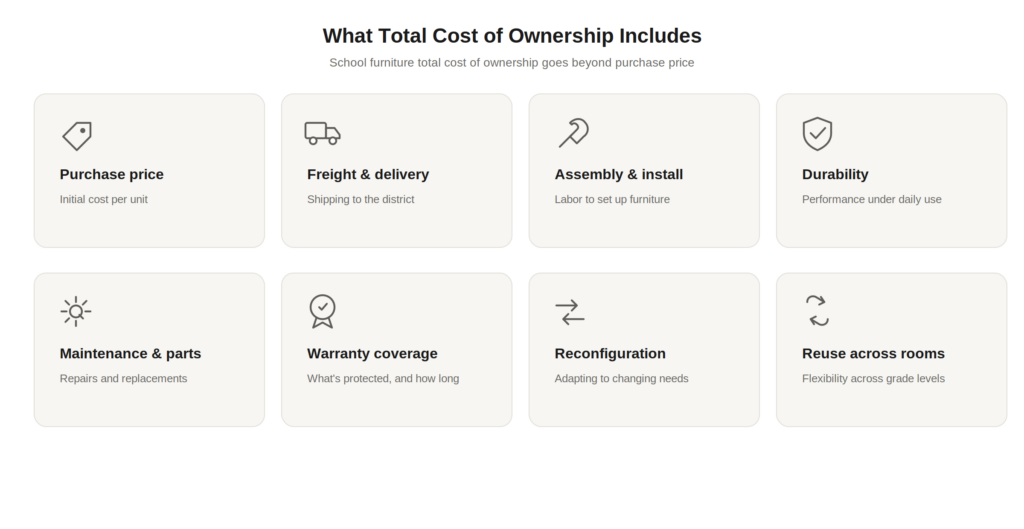
For school furniture, those considerations may include:
Initial purchase price
Freight and delivery
Assembly and installation
Product durability
Maintenance and replacement parts
Warranty coverage
Reconfiguration costs
Replacement frequency
- Ability to reuse furniture in different classrooms or grade level
Looking at these factors together gives purchasing teams a more complete picture of what a furniture investment may cost over time.
Purchase Price Is Only the Beginning
Purchase price matters. School districts have budgets, and every furniture project has financial limits.
But the lowest initial price does not automatically represent the lowest long-term cost.
Consider two classroom desks with different purchase prices. If one remains in service substantially longer or can be adapted as classroom requirements change, its annualized cost may ultimately be lower.
A simple way to begin thinking about value is:
Total cost of ownership ÷ years of useful service = approximate annual cost

This isn’t a complete procurement formula, but it illustrates why useful life matters.
A $150 product replaced after five years represents a different long-term investment than a $200 product that remains functional for ten years.
The question therefore becomes more than
“How much does this furniture cost?”
It becomes:
“What will this furniture cost us over the years we expect to use it?”

Durability Can Change the Long-Term Equation
K-12 furniture experiences demanding daily use.
Students move chairs, reposition desks and tables, roll mobile products between configurations and use the same furniture throughout the school year. Products selected for these environments should be evaluated for the performance demands of their intended application.
Industry testing standards can provide useful information when comparing products. The Business and Institutional Furniture Manufacturers Association (BIFMA) develops furniture safety and performance standards that help specifiers and buyers evaluate products for institutional environments.
When evaluating durability, districts and specifiers can ask:
Has the furniture been tested to applicable performance standards?
What materials are used in the frame and work surface?
Which components receive the greatest wear?
Are replacement components available?
How is the product expected to perform under daily institutional use?
What does the manufacturer’s warranty actually cover?
Paragon furniture is tested against applicable ANSI/BIFMA standards through independent third-party laboratories, with additional testing performed in Paragon’s in-house testing lab.
Learn more about K-12 school furniture safety standards and product testing.
Warranty Coverage Deserves a Closer Look
A warranty can provide useful insight into the manufacturer’s stated coverage of a product, but simply comparing the words “lifetime warranty” isn’t enough.
Purchasing teams should examine:
How the manufacturer defines “lifetime”
Which structural components are covered
Whether moving or mechanical components have different coverage periods
What exclusions apply
Whether proof of purchase is required
How warranty claims are handled
Paragon provides a Limited Lifetime Structural Warranty, defined as 12 years, on qualifying chair, desk and table frames, work surfaces and specified seating products. Certain high-use components, including casters and glides, carry separate five-year coverage, while other mechanical or electrical components have their own terms.
Review Paragon Furniture’s complete warranty and terms.
Looking at these details allows districts to evaluate warranty protection alongside expected service life rather than treating all warranties as equivalent.
Flexible Furniture May Reduce Future Replacement Needs
Today’s classroom may not serve the same purpose five years from now.
Enrollment changes. Teaching methods evolve. Classrooms are reassigned. A traditional classroom may become a collaborative learning space, STEM room or makerspace.
Furniture that can adapt to those changes may have value beyond its original application.
Mobile tables and storage, adjustable-height desks and flexible seating can allow existing furniture to serve different configurations rather than requiring an entirely new furniture package.
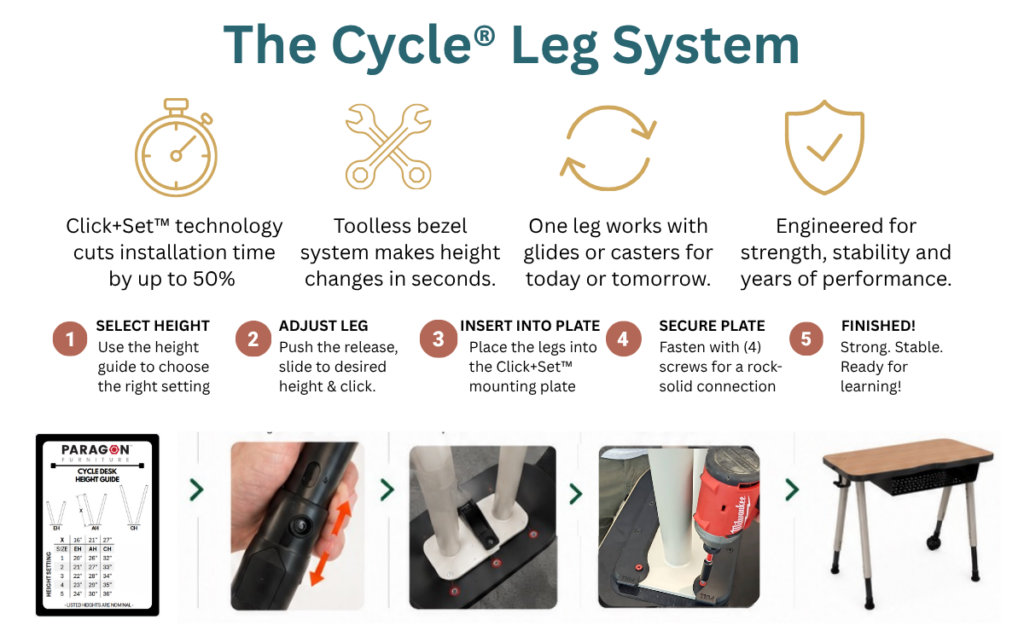
Paragon’s Cycle® Series, for example, was designed around changing classroom needs. Cycle student desks use the Click+Set® leg system with numbered height settings. The reversible lower leg and bezel can be configured for either glides or casters without requiring separate leg assemblies.
That means districts can consider mobility and height requirements within one furniture platform instead of automatically treating every configuration as a separate furniture purchase.
Learn how to plan adaptable learning environments in Paragon’s Classroom Space Planning Guide.
Assembly and Installation Are Part of the Cost
The price on a furniture quote isn’t necessarily the final cost of getting that furniture into a classroom.
Depending on the project, additional costs may include:
Freight
Receiving
Unloading
Storage
Assembly
Installation labor
Moving furniture into individual rooms
Packaging removal
Construction delays or rescheduling
On a district-wide project involving hundreds or thousands of pieces, small differences in assembly requirements can multiply quickly.
Schools should therefore understand how products arrive, how much assembly is required and who is responsible for installation before comparing final project costs.
Delivery planning can also help reduce avoidable costs associated with access problems, damaged shipments, insufficient receiving space or scheduling conflicts.
Standardization Can Create Long-Term Efficiencies
For larger districts, total cost of ownership isn’t always about an individual chair or desk. It can also involve how easily furniture can be managed across multiple campuses.
Standardizing selected furniture platforms may make it easier to:
Move furniture between classrooms
Reuse products when enrollment changes
Maintain consistent classroom configurations
Manage replacement components
Reconfigure spaces
Train facilities personnel
Coordinate future purchases
For a school district, that means a purchasing decision made for one classroom can have implications far beyond that room.
Standardization doesn’t mean every classroom has to look the same. It means considering whether products, components and furniture systems can work together across different learning environments and continue to serve the district as needs change.
Replacement Parts Can Extend Useful Life
A damaged caster shouldn’t necessarily mean replacing an entire chair.
Likewise, a worn glide, work surface or other replaceable component may be far less expensive to address than replacing the complete piece of furniture.
When evaluating manufacturers, districts should ask whether replacement parts are available and what information will be required to identify older products.
The ability to service furniture rather than automatically replace it can become increasingly important as a district’s installed furniture inventory grows.
Indoor Environmental Quality Is Part of Long-Term Value
Furniture decisions can also affect the indoor learning environment.
The U.S. Environmental Protection Agency’s Indoor Air Quality Design Tools for Schools recommends considering low-toxicity and low-emitting materials when selecting materials and furnishings for schools.
For districts and specifiers, reviewing applicable product certifications and material information can therefore be another part of evaluating a furniture investment.
Information about testing, certifications, product dimensions, materials, finishes and other specification resources should be reviewed before products are selected.
Explore Paragon’s K-12 Furniture Resources for architects, designers, dealers and district teams.
How Should Schools Compare the Total Cost of Furniture?
Before making a final purchasing decision, districts can evaluate each option using the same questions:
Purchase: What is the initial furniture cost?
Delivery: What freight, receiving and installation costs should be expected?
Durability: Has the product been tested for the demands of institutional use?
Warranty: What is covered, for how long and under what conditions?
Maintenance: Are common wear components replaceable?
Flexibility: Can the furniture adapt to different students, rooms or learning configurations?
Standardization: Could the product be used across multiple classrooms or campuses?
Replacement: What is the realistic expected service life?
Looking at these factors together gives decision-makers a better basis for comparing long-term value.
Investing Beyond the First Day
The best value in school furniture isn’t necessarily the product with the lowest price or the highest price.
It’s the product that appropriately meets the school’s requirements while delivering the performance, flexibility and service life expected from the investment.
For districts, architects and purchasing teams, evaluating school furniture total cost of ownership can shift the conversation from what furniture costs on purchase day to what it costs throughout its useful life.
That broader perspective can help schools make purchasing decisions that work not only for today’s classroom, but for the students, spaces and budgets that follow.
Frequently Asked Questions About School Furniture Total Cost of Ownership
What does total cost of ownership mean for school furniture?
Total cost of ownership considers the initial purchase price plus costs that may occur throughout the furniture’s useful life, including delivery, assembly, maintenance, replacement parts, reconfiguration and eventual replacement.
Is less expensive school furniture always cheaper in the long run?
Not necessarily. Initial price is only one factor. Useful life, maintenance requirements, warranty coverage and replacement frequency can significantly affect long-term cost.
Why does warranty coverage matter when comparing school furniture?
Warranty terms show which components the manufacturer covers and for how long. Schools should compare actual written coverage rather than relying only on warranty labels such as “lifetime.”
Can flexible classroom furniture reduce long-term costs?
Potentially. Furniture that can be adjusted, moved or reconfigured may be usable across different classrooms, grade levels and learning activities, reducing the need to purchase separate furniture for every change in use.
What should districts consider besides school furniture price?
Districts should consider durability, applicable performance testing, warranty coverage, delivery and assembly requirements, replacement-part availability, flexibility, expected service life and future reconfiguration needs.